
Or, The End of Positive Correlation
I bet a lot of you are currently deciding whether to run some sort of digital ad - whether on social media, a more niche channel like Reddit, or SEO and GEO (SEO for AI). It’s the natural step after customer interviews. You develop a thesis, pick a Frank (first customer), then want to see if there are more people out there like that Frank.
Digital ads of any kind are almost certainly the worst approach you can take here but I understand why you’d want to try And, the reason you’re drawn to them is the point of this post.
Longing for Positive Correlation
A few years back I came up with an idea I call “Longing for Positive Correlation,” or LPC. I hate the name and it hasn’t caught on at all, but it describes something very important.
For your entire life, effort and outcome were correlated positively. Like this:
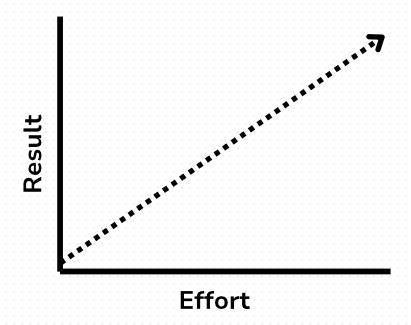
The line might’ve had some bumps, but, in general, if you cut out sugar and ran five times a week you’d get better at running and lose some weight. Put in effort, get a result.
The Result to Effort ratio is reliable in just about every part of our lives except startups, and this smacks founders in the face pretty quick.
Everyone starts Tacklebox with Customer Interviews and Customer Interviews are uncomfortable, so every founder asks me the same question:
“How many customer interviews do I need to run?”
Or, translated, “how much Effort is needed before I get my Result?”
The answer is, obviously, the shrug emoji.
A great customer might emerge after your second or fifth or fifteenth interview. It also might never emerge because there was never anything there to find - it’s entirely possible (likely) that the problem you thought was such a big opportunity just wasn't. Capitalism is pretty efficient.
The path nearly all of our successful founders take starts there - they interview a bunch of people and find out that their initial hypothesis was wrong. But during those interviews they find a thread worth pulling on which leads them to a new set of customers or a new problem entirely. This might lead to a breakthrough or to another thread worth pulling.
Running interviews and getting nowhere doesn’t feel like progress but it is - it’s just more of the Edison “I haven’t failed, I’ve just found 10,000 ways that don’t work” type rather than the comfy cozy “I do X and I am guaranteed Y” type.
The Startup Staircase Growth Chart
Here’s what the progress actually looks like:
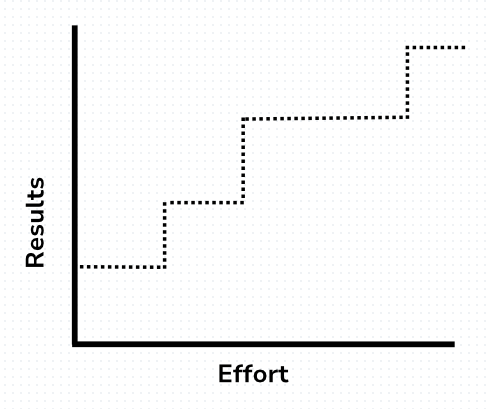
There will be a flat period where it feels like nothing is happening. There’s no telling how long it’ll last or what the insight is that’ll free you from it. You’ll try three or five or twenty things and eventually one will work and you’ll move up. You’ll jump to the next level, then be flat again.
Back to Digital Ads
When you’re stuck on that flat part of the staircase, anything that looks like it’s got some predictable slope is irresistible. This is why digital ads, building a product or paying someone to build one for you, fundraising - all seem so attractive. We put in effort (or money) and we get a result.
You give an agency or Facebook or Instagram or TikTok money and a few hours later they show you a graph:
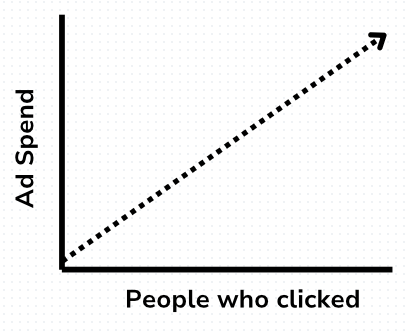
And once you’ve got that graph boy oh boy can you optimize it. You can talk about nuances in language and tweak the age range and decide to include Duluth as a “test.” Optimizing is fun because optimizing implies you’ve done something worth optimizing. Optimizing calms your nervous system. You know how to optimize things.
Except that at this stage, any graph that’s reliably up and to the right is just someone trying to sell you something. That is not how early stage startups make progress so it is not showing your startup making progress.
Your first customer cannot be targeted broadly, so the “people who clicked” will not be the group you want. The targeting for ads will never be tight enough because if it was our customer segment wouldn’t exist - the whole point of a customer segment is that the boundaries you create around that group are hidden to everyone but you. They can’t be found with a combination of dropdowns on instagram ads.
We’ll talk next week about the far better alternative to digital ads at this stage. One that embraces - and supports - staircase growth.
And, in the meantime, if anyone ever promises you the familiar “put in X and you’re guaranteed to get Y” pitch, remember what our good friend Clint Eastwood said:
“If you want a guarantee, buy a toaster.”